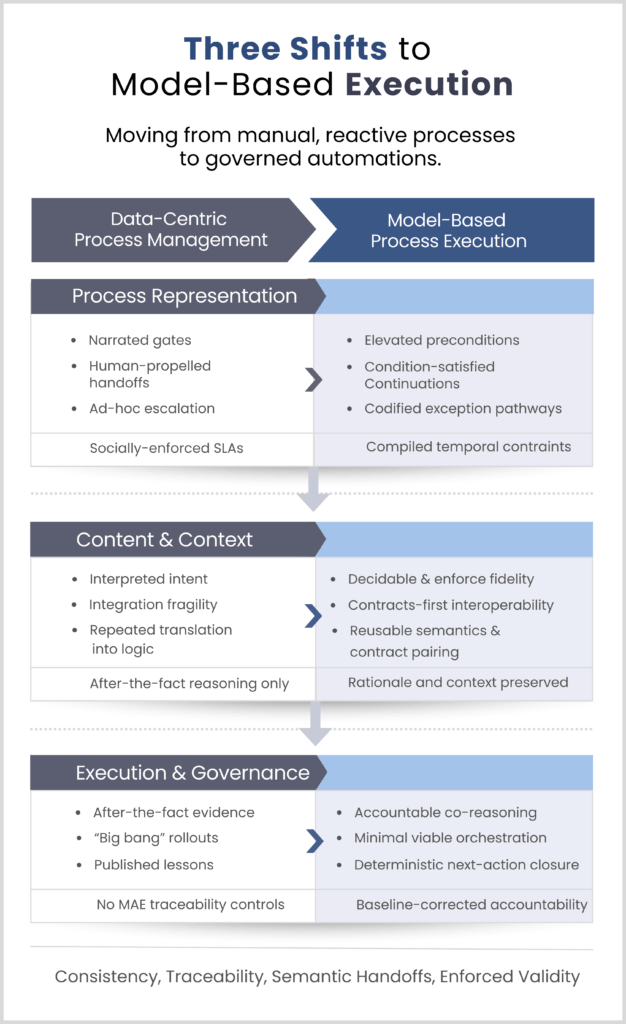
When process details including deliverables and timing milestones, are encoded as cognition models, the process becomes executable. Data driven process management turns into model-based process execution. Manual triggers are replaced by triggers that fire when conditions are met. Executable models carry forward rich & authoritative content, connected by intelligent parameter threads – preserving traceability and eliminating context loss at gates. And because execution is driven by semantic models that preserve baseline/validity/decision lineage across tools, the benefits accrue – leading to gate cycle-time reduction, fewer rework loops/escapes, and faster audit preparation.
A “Process” can be fully complex spanning the entire product lifecycle from functional requirements and detailed specifications to production and quality – and across warranty management through lessons learned. Or it can be a less complex subset within it. In most engineering and manufacturing enterprises a process is all the above, with a vast array of sub-processes nested within them. These span concept feasibility, design review, manufacturing readiness, supplier qualification, first article inspection, etc.
The Challenges
As diverse as the processes and their unique needs are, they share the same common executive functions, and not surprisingly the same common maladies.
Much of this is attributable to the same root cause. Processes are created as narratives with text, flow charts, and diagrams. They tell a good story; they are readable and relatable. But they are managed, not executed, and rely on human triggers to mobilize the process (often as antiquated as an e-mail with a CC to the manager, or a Slack message.)
The Solution
What happens when processes are model-based and become executable instead? Let us look at a simple example. Most processes have sequences of gates (or logical segments,) with as few as four or as many as dozens of gates. Each gate has numerous deliverables and timing milestones associated with them. In AurosIQ, these gates are encoded as executable logic and become computable boundaries. Successor steps are triggered automatically, in timely fashion, when all the pre-conditions are met. Better yet, Model-Based Cognition ensures semantic continuity across gates. When work crosses a gate, identity, time, baseline, validity, and decision history are carried forward automatically.
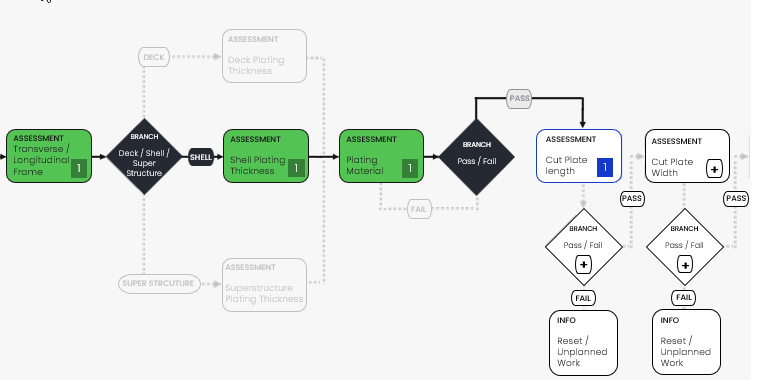
Model-Based Process Execution relies on cognition models which encode rich & authoritative content connected by intelligent parameter threads. Models create context that drives the provisioning of sub-models which makes the process cognitive. These cognition models develop and evolve organically to enable autonomy with interoperability. AurosIQ achieves this through Communities of Practice (COPs). Process owners can create their own COPs, administer configurations, and evolve models independently.
These spaces are not silos; everything inside them is interoperable across COP boundaries. The advantage is that learning does not have to be centralized to become consistent, and consistency does not require suppressing plant and program authorship.
The Solution
What happens when processes are model-based and become executable instead? Let us look at a simple example. Most processes have sequences of gates (or logical segments,) with as few as four or as many as dozens of gates. Each gate has numerous deliverables and timing milestones associated with them. In AurosIQ, these gates are encoded as executable logic and become computable boundaries. Successor steps are triggered automatically, in timely fashion, when all the pre-conditions are met. Better yet, Model-Based Cognition ensures semantic continuity across gates. When work crosses a gate, identity, time, baseline, validity, and decision history are carried forward automatically.
Model-Based Process Execution relies on cognition models which encode rich & authoritative content connected by intelligent parameter threads. Models create context that drives the provisioning of sub-models which makes the process cognitive. These cognition models develop and evolve organically to enable autonomy with interoperability. AurosIQ achieves this through Communities of Practice (COPs). Process owners can create their own COPs, administer configurations, and evolve models independently.
These spaces are not silos; everything inside them is interoperable across COP boundaries. The advantage is that learning does not have to be centralized to become consistent, and consistency does not require suppressing plant and program authorship.
The Benefits
There are four key objectives that drive all process management efforts. Model-Based Process Execution delivers on all of them, as automatic products of encoding a process as a logical model and then executing that logic. “It is right there when you are done” replaces time consuming and error prone assembly of evidence post facto.
Insert text to encourage the exploration of other use cases using the use case wheel.