
Model-Based Requirements & Specifications
Suppliers to the Automotive and Aerospace industries measure success and excellence by a key metric – how well they execute on incoming requirements and specifications. Yet this noble goal is stymied from inception by the sheer volume of data and text in the documents and files.
For a tier-1 auto supplier, the volume is amplified by specs from multiple OEMs, across dozens of concurrent projects – all variations of the same core product. For an aerospace supplier the volume derives from regulatory compliance embedded directly into specs, zero-defect quality mandates, and explicit requirements for traceability. In both cases current solutions rely on manual, resource intensive, and painstaking management – with automation seemingly unattainable.
Agentic AI from AurosIQ solves this problem, hereto thought to be intractable – it composes and executes cognition models of requirements and specifications by encoding data, logic, constraints, and parameters. With parameter threading, every downstream activity from engineering to manufacturing, is informed by, and executed on the same governing intent – assuring compliance, quality and a fully traceable evidence trail.
Model-Based Requirements & Specifications eliminate laborious and manual reconciliation of data and text, scattered across documents and tools. Organizations save costs and prevent costly errors by allowing requirements to align, evolve, and be verified consistently across programs and customers.
Suppliers to the Automotive and Aerospace industries measure success and excellence by a key metric – how well they execute on incoming requirements and specifications. Yet this noble goal is stymied from inception by the sheer volume of data and text in the documents and files.
For a tier-1 auto supplier, the volume is amplified by specs from multiple OEMs, across dozens of concurrent projects – all variations of the same core product. For an aerospace supplier the volume derives from regulatory compliance embedded directly into specs, zero-defect quality mandates, and explicit requirements for traceability. In both cases current solutions rely on manual, resource intensive, and painstaking management – with automation seemingly unattainable.
Agentic AI from AurosIQ solves this problem, hereto thought to be intractable – it composes and executes cognition models of requirements and specifications by encoding data, logic, constraints, and parameters. With parameter threading, every downstream activity from engineering to manufacturing, is informed by, and executed on the same governing intent – assuring compliance, quality and a fully traceable evidence trail.
Model-Based Requirements & Specifications eliminate laborious and manual reconciliation of data and text, scattered across documents and tools. Organizations save costs and prevent costly errors by allowing requirements to align, evolve, and be verified consistently across programs and customers.
At a Think Tank hosted by AurosIQ, and in the ensuing deployment phase, leading suppliers concurred on two key objectives.
Automation through Agentic AI must address the most critical failure modes of document-centric, labor intensive, managed processes:
Further, it must anticipate and proactively prevent additional failure modes amplified or caused by an AI implementation. “Intelligence applied downstream cannot compensate for ambiguity upstream.”
Interestingly, all these challenges derive from the fact that requirements and specifications are defined in documents as text and data – without explicit encoding of logic and with context subject to interpretation.
The Solution
AurosIQ defines the next state-of-the-art with key technology/product innovations.
Cycles Composer (Figure 1) is an Agentic AI implementation whose prime directive is to convert requirements defined in authoritative source documents into actionable models that can serve as the content substrate for Model-Based Requirements & Specifications. External and internal requirements, standards, constraints, heuristics, and decision rules are ingested, codified, curated, and provisioned as executable logic. The resulting content space is not only structured but connected across contexts via shared parameters. The Cycles Composer is agentic in its function, but the extent of agency is fully governed by human experts.
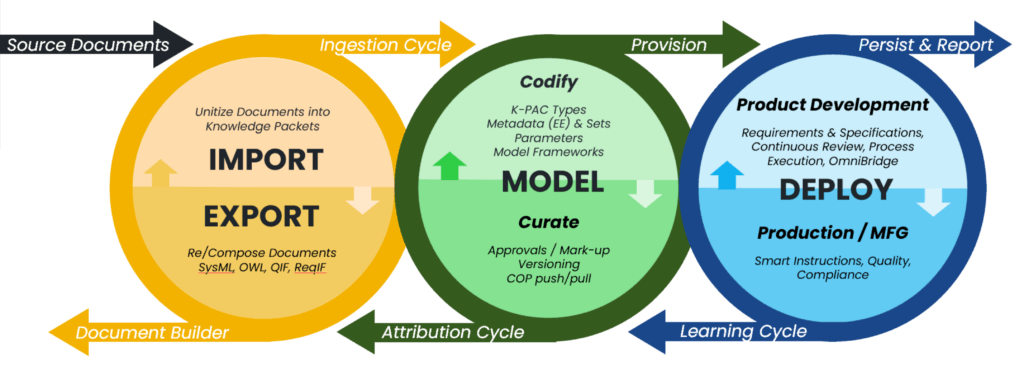
Figure 1.
Reverse Attribution (Figure 2) is a continuous, AI-driven reconciliation process that evaluates inbound specification content against requirements already modeled in AurosIQ as Knowledge Packets (K-PACs.)
If a logical equivalence is established, instead of generating a duplicate record, the system:
If specification elements are not covered by any existing authoritative K-PAC a new requirement entity in the form of a fresh K-PAC is auto-generated. The system supports many-to-one mappings, where multiple specification clauses resolve into a single authoritative requirement.
Reverse Attribution operates continuously as specifications evolve. When a new version of a specification is introduced, existing attributions are re-evaluated, and changes in specification language are assessed against current K-PAC logic. Both specification versions and K-PAC versions remain explicitly traceable, preserving historical lineage and authoritative mapping over time.
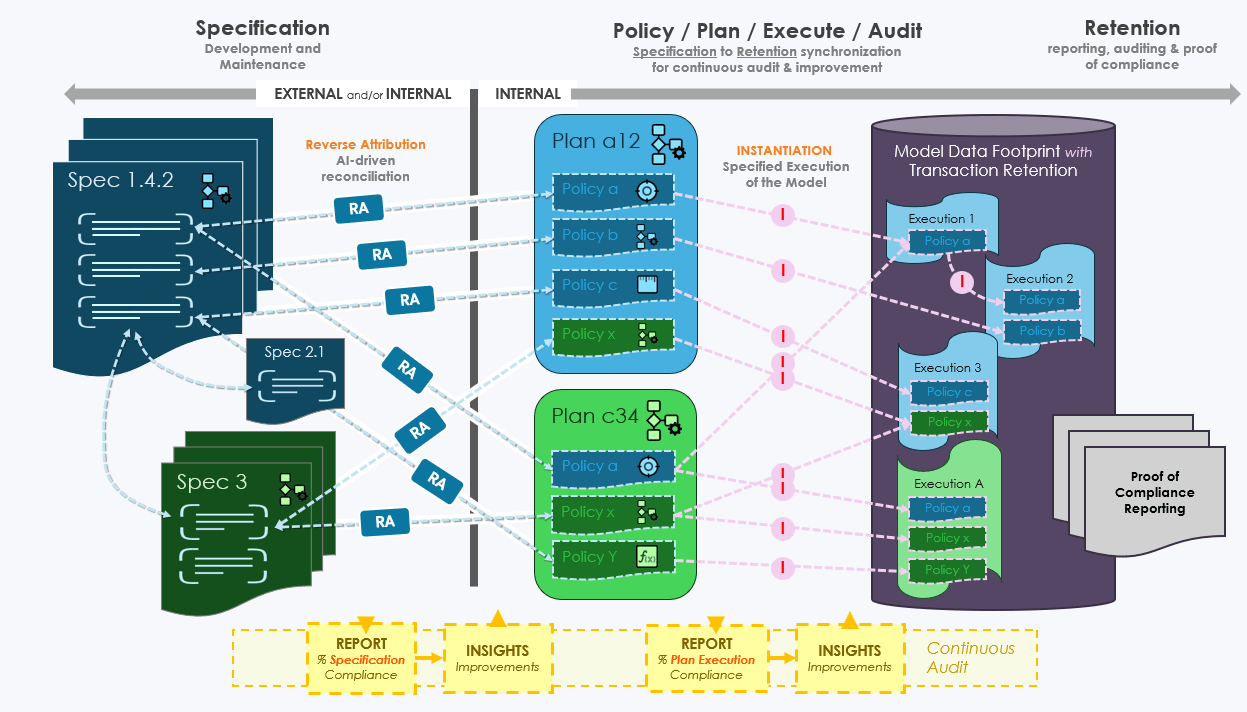
Figure 2.
The Benefits
Model-Based Requirements & Specifications turn unscalable interpretation of voluminous data and documents into executable cognition models that scale – across multiple OEMs and programs, and down tier-supplier chains. Manual processes are replaced by Agentic AI automation resulting in continuous compliance and built-in traceability.
Insert text to encourage the exploration of other use cases using the use case wheel.
