OmniBridge™

OmniBridge facilitates the integration of AurosIQ within customer workflows and/or with other tools in the customer workflows. Most integrations support bi-directional data transfer, and AurosIQ can function as the Origin App or the Destination App.


OmniBridge supports two primary integration mechanisms.


  • Direct Data Exchange


The most used data formats are:

JSON – Ideal where simplicity, speed, and seamless integration with JavaScript are desired. Examples include data visualization, real-time data handling etc.


XML – Best for integrations requiring rich metadata, namespaces, or strict schema validations. Examples include ERP, work requests etc.


SQL – Read-only transactional replication as well as bi-directional links through staging tables in a Neutral Zone enable powerful, real-time concurrent engineering with collaborating tools.


The HELP API built into AurosIQ acts as a hub to access API documentation. It is implemented as a CoP (Community of Practice) and includes native content. The community also includes links to various API resources.
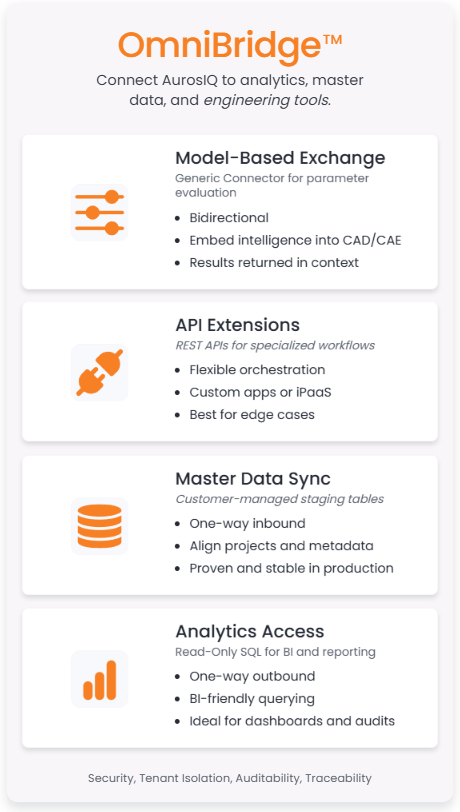
OmniBridgeTM

Connect AurosIQ to analytics, master data, and engineering tools.

Model-Based Exchange

Generic Connector for parameter evaluation

  • Bidirectional
  • Embed intelligence into CAD/CAE
  • Results returned in context

API Extensions

REST APIs for specialized workflows

  • Flexible orchestration
  • Custom apps or iPaaS
  • Best for edge cases

Master Data Sync

Customer-managed staging tables

  • One-way inbound
  • Align projects and metadata
  • Proven and stable in production

Analytics Access

Read-Only SQL for BI and reporting

  • One-way outbound
  • BI-friendly querying
  • Ideal for dashboards and audits
Security, Tenant Isolation, Auditability, Traceability


  • Model-Based Plug-Ins

Model data (parameters) can be exchanged with 3rd party software through custom plug-ins. This enables bi-directional sharing of enumerated cognition models including logic, constraints, and parameters – effectively upgrading the entire workflow to be “IQ enabled.”


Integration Simulator – Used to get model data out of AurosIQ and emulate/visualize how the models are collectively executed outside of the AurosIQ web interface. Also, to pass data back to AurosIQ and see what the data looks like in AurosIQ. The Integration Simulator is lightweight and is ideal for experimenting with different options and defining the specs for the integration.


Integration Toolkit – Allows an organization to build custom plug-ins between AurosIQ and other tools in the workflow with “last mile” coding only. It is the first half of the bridge and represents a secondary application interacting with Auros IQ data. The Integration Toolkit provides an API run book to create low code connectors to 3rd party tools.


The following are some examples of integrations by AurosIQ customers in engineering and manufacturing:


Business Intelligence (BI) Platforms

The most popular 3rd party applications integrated with AurosIQ are Business Intelligence platforms like Microsoft Power BI, Tableau, and SAP Analytics Cloud. While there is significant reporting capability in AurosIQ, many customers find a need for specialized reports, or to blend data from multiple systems. Well-designed custom integrations allow engineering and manufacturing teams to generate multiple, and frequently repeated visualizations, dashboards, and reports with little to no manual effort.


  • A top-3 European auto manufacturer has built a custom integration between AurosIQ and their native Tableau BI implementation. For each vehicle program, production parts from every supplier with supplier data, supplier ratings, part listings, and approval forms are created (modeled) in AurosIQ. The entire part-approval process including reviews, evaluations, supplier responses and approval statuses is executed within AurosIQ and monitored in the BI tool.


  • A global leader in EV solutions uses AurosIQ for planning and process execution of the program management process for their EV Drivetrain. High-level program information including timing, product requirements, functional specifications, supply chain, manufacturing specifications, and quality metrics is tracked and communicated to executive oversight. A seamless integration between AurosIQ and their preferred BI Platform enables them to blend AurosIQ data with cost, resource planning, and other data from adjacent systems – and create data analytics, dashboards, and visualizations for review and audit.


Enterprise Resource Planning (ERP) Systems

The most popular ERP systems among OEMs and large Tier-1 customers of AurosIQ are SAP S/4HANA, Oracle Cloud ERP, and Infor CloudSuite (A&D, Automotive, or Industrial.) All integrations are bi-directional and project metadata and status are typically exchanged.


  • One of the largest automotive companies in the world has built a custom integration between AurosIQ and SAP-based ERP data from suppliers for interior design. Through this connector, things like project name, attributes of the project, and planned timing events get communicated to AurosIQ. Adherence to those timing events is usually based on completion of assessments, and status of said assessments is communicated back to the ERP system.


  • A top-3 North American manufacturer of heavy trucks and buses has developed and deployed a custom integration between AurosIQ, and their internally developed work-order tracking tool based on a commercial ERP system. They initiate work requests from line items in an AurosIQ Assessment, and when fulfilled, the associated completion data is then written back to the Assessment line item that the request was initiated from.


Project Management Tools

While a few very large OEMs still use ERP systems for project management, most AurosIQ customers, especially small to mid-size tier suppliers have adopted more agile solutions like cplace, Asana, or Clarity. These tools are well designed to handle complex, cross-company projects typical in automotive and aerospace R&D including e-mobility, autonomous and connected systems.


  • A top-3 European tier-1 supplier has built a custom connector between AurosIQ and their PM tool cplace. The connected AurosIQ/cplace solution is used to plan and execute an entire product development process from inception to final sign-off. Detailed project plans, product requirements, standards, and metrics for verification and quality are created and maintained in AurosIQ. Detailed tasks, schedules, and resource allocation are managed in cplace. AurosIQ acts as the Destinations App in this implementation and awaits triggering events from cplace to automatically generate new projects, activate a specific numbered project based on risk assessments, and execute multiple milestone reviews from requirements to product validation.


Smart CAD (Computer-Aided Design)

Smart CAD integrates AurosIQ with popular CAD systems like NX, Catia, and Creo. Customers can use off-the-shelf CAD connectors from Auros or build custom connections.


Smart CAD dynamically provisions cognition models of requirements, specifications, and standards in AurosIQ directly into CAD sessions based on context cues. This enables real-time parameter validation, rule-based design recommendations, and traceable compliance – eliminating ambiguity, rework, and costly manual reviews. In addition, flexible and real-time reporting, real-time look-across, and on demand insights and analytics for key parameters are also supported.


  • A leading supplier of driveline technologies uses a custom-built CATIA/AurosIQ connector to develop and deploy fully parameterized AWD system designs.


  • A global automotive OEM uses a custom-built NX/AurosIQ connector to enforce manufacturing requirements into NX part templates.


  • A leading tier-1 automotive manufacturer has implemented a custom AurosIQ integration with Cadence Allegro PCB Layout tool. DFM rules built in AurosIQ are used to perform PCB design rule conformance checks and reviews.


In addition, AurosIQ can be integrated with 3rd party MES, CAE, PLM, and bench testing applications.


Internal Power Apps (IPA)

Many engineering and manufacturing enterprises have developed proprietary internal software tools which encapsulate their domain-specific intellectual property. These IPAs expose endpoints via APIs enabling secure, real-time model data exchange with AurosIQ.


  • A leading Japanese energy company uses a custom, internally developed software tool to create detailed build-specs for step-up and step-down transformers in renewable microgrids. Fully parametrized models for the transformers were built in AurosIQ, including sets of tolerance and build capability rules. These rules had dependencies at the category level and at the calculation-parameter level. The rules were then “served” to the work-instructions system, so the calculations happened in a way that was specific to the context of the build.


  • A prominent US National Laboratory has built a secure connector between their custom developed AI infrastructure and AurosIQ. Enterprise knowledge, peer review checklists, lessons learned etc. are developed and maintained in AurosIQ, and the AI infrastructure manages the knowledge sharing process through search, find, and apply to relevant context.


  • A major tier-1 supplier to the Defense & Aerospace industry has built a custom workflow integrating Dassault DELMIA, AurosIQ, and a proprietary Torque calculator. This workflow spans engineering, planning, and shop floor operations – with plant floor mechanics accessing standard work instructions from DELMIA. Static manuals have been replaced with real-time, smart instructions, with over 10,000 torque instantiations executed daily. Engineers and mechanics now receive precise, contextual guidance as they work, closing quality gaps and surfacing long-buried process issues.
  • Direct Data Exchange


The most used data formats are:


JSON – Ideal where simplicity, speed, and seamless integration with JavaScript are desired. Examples include data visualization, real-time data handling etc.


XML – Best for integrations requiring rich metadata, namespaces, or strict schema validations. Examples include ERP, work requests etc.


SQL – Read-only transactional replication as well as bi-directional links through staging tables in a Neutral Zone enable powerful, real-time concurrent engineering with collaborating tools.


The HELP API built into AurosIQ acts as a hub to access API documentation. It is implemented as a CoP (Community of Practice) and includes native content. The community also includes links to various API resources.

OmniBridgeTM

Connect AurosIQ to analytics, master data, and engineering tools.

Model-Based Exchange

Generic Connector for parameter evaluation

  • Bidirectional
  • Embed intelligence into CAD/CAE
  • Results returned in context

API Extensions

REST APIs for specialized workflows

  • Flexible orchestration
  • Custom apps or iPaaS
  • Best for edge cases

Master Data Sync

Customer-managed staging tables

  • One-way inbound
  • Align projects and metadata
  • Proven and stable in production

Analytics Access

Read-Only SQL for BI and reporting

  • One-way outbound
  • BI-friendly querying
  • Ideal for dashboards and audits
Security, Tenant Isolation, Auditability, Traceability
  • Model-Based Plug-Ins


Model data (parameters) can be exchanged with 3rd party software through custom plug-ins. This enables bi-directional sharing of enumerated cognition models including logic, constraints, and parameters – effectively upgrading the entire workflow to be “IQ enabled.”


Integration Simulator – Used to get model data out of AurosIQ and emulate/visualize how the models are collectively executed outside of the AurosIQ web interface. Also, to pass data back to AurosIQ and see what the data looks like in AurosIQ. The Integration Simulator is lightweight and is ideal for experimenting with different options and defining the specs for the integration.


Integration Toolkit – Allows an organization to build custom plug-ins between AurosIQ and other tools in the workflow with “last mile” coding only. It is the first half of the bridge and represents a secondary application interacting with Auros IQ data. The Integration Toolkit provides an API run book to create low code connectors to 3rd party tools.


The following are some examples of integrations by AurosIQ customers in engineering and manufacturing:


Business Intelligence (BI) Platforms

The most popular 3rd party applications integrated with AurosIQ are Business Intelligence platforms like Microsoft Power BI, Tableau, and SAP Analytics Cloud. While there is significant reporting capability in AurosIQ, many customers find a need for specialized reports, or to blend data from multiple systems. Well-designed custom integrations allow engineering and manufacturing teams to generate multiple, and frequently repeated visualizations, dashboards, and reports with little to no manual effort.


  • A top-3 European auto manufacturer has built a custom integration between AurosIQ and their native Tableau BI implementation. For each vehicle program, production parts from every supplier with supplier data, supplier ratings, part listings, and approval forms are created (modeled) in AurosIQ. The entire part-approval process including reviews, evaluations, supplier responses and approval statuses is executed within AurosIQ and monitored in the BI tool.


  • A global leader in EV solutions uses AurosIQ for planning and process execution of the program management process for their EV Drivetrain. High-level program information including timing, product requirements, functional specifications, supply chain, manufacturing specifications, and quality metrics is tracked and communicated to executive oversight. A seamless integration between AurosIQ and their preferred BI Platform enables them to blend AurosIQ data with cost, resource planning, and other data from adjacent systems – and create data analytics, dashboards, and visualizations for review and audit.


Enterprise Resource Planning (ERP) Systems

The most popular ERP systems among OEMs and large Tier-1 customers of AurosIQ are SAP S/4HANA, Oracle Cloud ERP, and Infor CloudSuite (A&D, Automotive, or Industrial.) All integrations are bi-directional and project metadata and status are typically exchanged.


  • One of the largest automotive companies in the world has built a custom integration between AurosIQ and SAP-based ERP data from suppliers for interior design. Through this connector, things like project name, attributes of the project, and planned timing events get communicated to AurosIQ. Adherence to those timing events is usually based on completion of assessments, and status of said assessments is communicated back to the ERP system.


  • A top-3 North American manufacturer of heavy trucks and buses has developed and deployed a custom integration between AurosIQ, and their internally developed work-order tracking tool based on a commercial ERP system. They initiate work requests from line items in an AurosIQ Assessment, and when fulfilled, the associated completion data is then written back to the Assessment line item that the request was initiated from.


Project Management Tools

While a few very large OEMs still use ERP systems for project management, most AurosIQ customers, especially small to mid-size tier suppliers have adopted more agile solutions like cplace, Asana, or Clarity. These tools are well designed to handle complex, cross-company projects typical in automotive and aerospace R&D including e-mobility, autonomous and connected systems.


  • A top-3 European tier-1 supplier has built a custom connector between AurosIQ and their PM tool cplace. The connected AurosIQ/cplace solution is used to plan and execute an entire product development process from inception to final sign-off. Detailed project plans, product requirements, standards, and metrics for verification and quality are created and maintained in AurosIQ. Detailed tasks, schedules, and resource allocation are managed in cplace. AurosIQ acts as the Destinations App in this implementation and awaits triggering events from cplace to automatically generate new projects, activate a specific numbered project based on risk assessments, and execute multiple milestone reviews from requirements to product validation.


Smart CAD (Computer-Aided Design)

Smart CAD integrates AurosIQ with popular CAD systems like NX, Catia, and Creo. Customers can use off-the-shelf CAD connectors from Auros or build custom connections.


Smart CAD dynamically provisions cognition models of requirements, specifications, and standards in AurosIQ directly into CAD sessions based on context cues. This enables real-time parameter validation, rule-based design recommendations, and traceable compliance – eliminating ambiguity, rework, and costly manual reviews. In addition, flexible and real-time reporting, real-time look-across, and on demand insights and analytics for key parameters are also supported.


  • A leading supplier of driveline technologies uses a custom-built CATIA/AurosIQ connector to develop and deploy fully parameterized AWD system designs.


  • A global automotive OEM uses a custom-built NX/AurosIQ connector to enforce manufacturing requirements into NX part templates.


  • A leading tier-1 automotive manufacturer has implemented a custom AurosIQ integration with Cadence Allegro PCB Layout tool. DFM rules built in AurosIQ are used to perform PCB design rule conformance checks and reviews.


In addition, AurosIQ can be integrated with 3rd party MES, CAE, PLM, and bench testing applications.


Internal Power Apps (IPA)

Many engineering and manufacturing enterprises have developed proprietary internal software tools which encapsulate their domain-specific intellectual property. These IPAs expose endpoints via APIs enabling secure, real-time model data exchange with AurosIQ.


  • A leading Japanese energy company uses a custom, internally developed software tool to create detailed build-specs for step-up and step-down transformers in renewable microgrids. Fully parametrized models for the transformers were built in AurosIQ, including sets of tolerance and build capability rules. These rules had dependencies at the category level and at the calculation-parameter level. The rules were then “served” to the work-instructions system, so the calculations happened in a way that was specific to the context of the build.


  • A prominent US National Laboratory has built a secure connector between their custom developed AI infrastructure and AurosIQ. Enterprise knowledge, peer review checklists, lessons learned etc. are developed and maintained in AurosIQ, and the AI infrastructure manages the knowledge sharing process through search, find, and apply to relevant context.


  • A major tier-1 supplier to the Defense & Aerospace industry has built a custom workflow integrating Dassault DELMIA, AurosIQ, and a proprietary Torque calculator. This workflow spans engineering, planning, and shop floor operations – with plant floor mechanics accessing standard work instructions from DELMIA. Static manuals have been replaced with real-time, smart instructions, with over 10,000 torque instantiations executed daily. Engineers and mechanics now receive precise, contextual guidance as they work, closing quality gaps and surfacing long-buried process issues.